


China Passed Food Security Law
On June 1st, China's new food safety law came into effect. It aims at regulating everything from land protection dedicated to cultivation and seed production, to the industrial production and processing of grains, their storage for use as regulatory stocks to balance supply and demand, especially during crises, and their marketing and emergencies that may arise in the supply side. The law mandates the central government and local governments to incorporate into their plans the provisions established to enhance the quantity and quality of grains and ensure their supply, with moderate dependence on imports.
The law aims to provide a framework that ensures food security in China for certain grains. Article 73 defines the term “grains” as wheat, rice, corn, soybean, miscellaneous grains, and the final product of processed grains. The new regulatory frame defines miscellaneous grain as millet, oats, sorghum, barley, buckwheat, highland barley, mung beans, potatoes, sweet potatoes, and others.
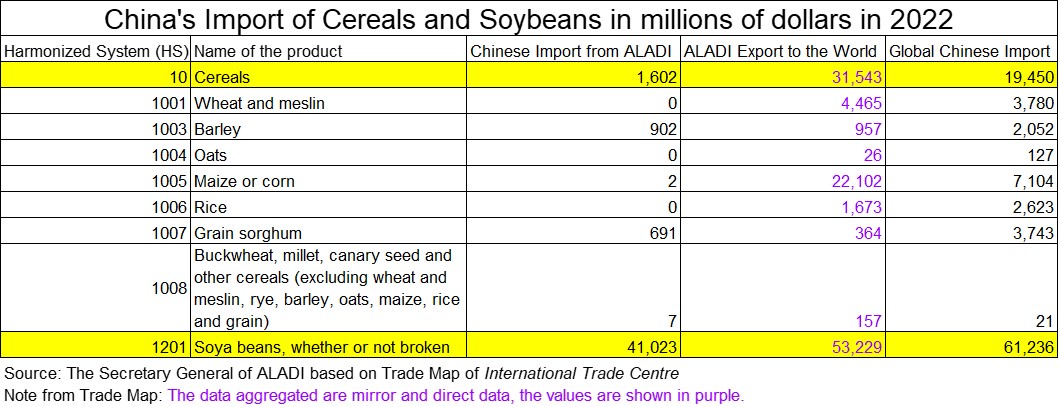
China is a producer and importer of grains and one of the countries with the most important stock regulators in corn, wheat, and rice. In 2022, China bought 42,625 million dollars worth of cereals and soybeans from the member states of ALADI. It is 50.83 percent of all the cereals and soybeans imported by China and 50,28 percent of the mentioned grains exported by the member states of ALADI.
Source: The Secretary General of ALADI based on the Department of Agriculture of the United States of America and Trade Map